Home-based Businesses
Deductions for home-based business expenses
A home-based business is one where an area of your home is set aside and used exclusively as a place of business.
The types of expenses you can claim depend on how you operate your business out of your home and the business structure. You can only claim deductions for the business portion of your expenses.
If you do not have an area set aside and used exclusively as a place of business but you do some work from home, you may still be able to claim a deduction for some of your expenses relating to the area you use.
Be aware that running a home-based business may have capital gains tax (CGT) implications when you sell your home – see below.
Remember, if your business is entitled to goods and services tax (GST) credits, also known as input tax credits, you can only claim a deduction for the GST exclusive amount of your expenses.
What expenses are deductible
If you operate some or all of your business from home, you may be able to claim tax deductions for the business portion of expense, including:
- occupancy expenses (such as mortgage interest or rent, council rates, land taxes, house insurance premiums) – see below;
- running expenses (such as electricity, phone, decline in value of plant and equipment, furniture and furnishing repairs, cleaning) – see below;
- the cost of motor vehicle trips between your home and other locations, if the travel is for business purposes.
Occupancy expenses
Occupancy expenses are expenses that you pay to own or rent your home. You can only claim occupancy expenses if the area of your house set aside for your business has the character of a “place of business” (including if most of your business is conducted online). Indicators that the area of your home that you’ve set aside is a place of business include:
- clearly identifiable as a place of business (such as a sign at the front of your house);
- not easily suitable or adaptable for private or domestic use;
- used exclusively or almost exclusively for your business;
- used regularly for business visits by your clients.
If you’re eligible to claim occupancy expenses, you can also claim running expenses (see below).
You usually calculate occupancy expenses based on the proportion of the floor area of your home that is a place of business and the proportion of the year it was used for business (the floor area method).
If you earn personal services income (PSI), you may not be able to deduct some occupancy expenses.
Running expenses
Running expenses relate to the use of facilities within your home.
You can claim additional running expenses you incur as a direct result of running your business from home, such as in a separate study or a desk in a lounge room, even if it doesn’t have the character of a “place of business”.
There are several ways to work out the business portion of your running expenses. You can use any calculation method, provided:
- it is reasonable in your circumstances;
- you exclude your normal (private) living costs;
- you have records to show how you calculated the business portion of the expense.
Actual cost method - where you can only claim the actual costs you incur due to running your business from home. To use this method, you need to keep all written evidence of your expenses, such as bills and receipts, and evidence to show how you worked out the business portion of your expenses.
Fixed rate method – you can deduct a fixed rate (currently 70 cents) for each hour you operate your business at home. This amount covers your deduction for energy expenses (electricity and gas), phone and internet usage, stationery, and computer consumables. For example, if you worked an average of 45 hours a week for 48 weeks of the year, your deduction using the fixed rate method would be 45 x 48 x 70c, which comes to $1,512.
To use this method, you must keep a record of all the hours worked from home for the entire year, using a diary, spreadsheet, or similar document. You must also keep one document or record, for example an invoice or bill, for each additional running expense you incurred during the year.
Floor area method – this is often the most appropriate method to work out the business portion of your running expenses. To use this method, keep your receipts, bills or other written evidence of your expenses.
Depreciation (decline in value) of business assets
If you use the fixed rate or floor area method, you can separately claim a deduction for the decline in value of depreciating assets, such as laptops, mobile phones and office furniture.
If you use assets for both personal and business use, you need to apportion your business depreciation expenses from personal based on your pattern of use.
If you have an aggregated turnover of less than $10 million, you can choose to use the simplified depreciation rules. If so, you may also be eligible for the $20,000 instant asset write-off.
Tip!
If you operate your business from your home, talk to your tax adviser so you can claim the correct deductions. Your tax adviser can also help you with record-keeping.
CGT implications for home-based business
If you qualify for the CGT main residence exemption, you don't pay tax on any capital gain when you sell your home and you ignore any capital loss.
Your eligibility for the main residence exemption may be impacted if you use any part of your home for income-producing purposes. You will only be entitled to a partial main residence exemption if the following apply:
- an area of your home is set aside and used exclusively as a place of business (you are running a home-based business);
- you are able to claim occupancy expenses;
- aside from you running a home-based business, you satisfy the main residence exemption eligibility conditions.
In this case, the main residence exemption does not apply to any capital gain or capital loss referable to the portion of your home used in the home-based business. The amount of capital gain or capital loss not subject to the exemption is the same as the percentage for which you would have been able to claim a deduction for mortgage interest. This is generally worked out based on the percentage of the floor area of your home set aside for business.
Example: apportionment of occupancy expenses
Elena and Mathew bought their home 10 years ago. Since then, Elena has used 10% of the floor area exclusively to run a home-based business. Elena generally runs her business for the full year.
Elena is entitled to claim a deduction for occupancy expenses. Elena and Mathew don't have a mortgage, but if they did, she would be able to claim a deduction for mortgage interest. As Mathew isn't involved in the business, he is not entitled to a deduction.
Elena apportions her occupancy expenses on a floor area basis to work out her deduction. Elena uses 10% of the home's floor area to run a home-based business, so she claims a deduction for 10% of her occupancy expenses.
If Elena continues to use her home in the same manner, and assuming they meet all eligibility conditions for the main residence exemption, Elena will apply the main residence exemption to disregard 90% of any capital gain or capital loss she makes from selling their home.
Elena can't apply the main residence exemption to disregard the remaining 10% of any capital gain or capital loss. However, she can apply the capital gains tax (CGT) 50% discount to reduce any remaining capital gain. [Note that the 50% discount will be replaced by cost base indexation and a minimum tax rate (30%) in relation to CGT events happening on or after 1 July 2027 – however, the 50% discount will continue to apply to gains attributable to the period up to 1 July 2027.]
As Mathew hasn’t used the house for the purpose of producing assessable income, he would be entitled to apply the full main residence exemption to disregard all of any capital gain or loss he makes from them selling their home.
Home-based business and the small business CGT concessions
In most cases, the mere running of a home-based business will not be sufficient to be meet the eligibility criteria to apply any of the small business CGT concessions to disregard, reduce or defer any capital gain you make from selling your home.
To apply the CGT concessions, you must meet the eligibility conditions, meaning that your home must be an active asset. As the active asset test must be applied to the asset as a whole, not just the portion used in business, in practice it will be rare that a property whose main use is private (as a home) will qualify.
Other ATO News
Payment by credit card
You may have read that the ATO is going to ban the use of credit cards to pay tax liabilities.
Originally, this was going to apply from 1 December this year. However, following discussions with the government and the provision of transitional funding, the ATO will continue accepting credit card payments for tax liabilities until 30 June 2027.
The ATO has said it will continue to consult with relevant stakeholders and stewardship groups to understand how best to support those experiencing financial hardship and identify alternative arrangements for businesses and individuals who are unable to pay via other methods.
Content creators – are you carrying on a business?
A content creator is an individual that produces and shares digital content online and receives amounts, including non-cash benefits, from that activity. The goal is typically to inform, entertain, educate, inspire, or persuade through the creation of different types of content.
Content can take many forms including videos, photos, written pieces, podcasts and live streams. Most content creators publish their content on digital platforms such as YouTube, TikTok, Twitch, Instagram and other websites, blogs, streaming or podcast platforms.
If you are a content creator your activities may include:
- creating and publishing digital content (such as videos, images, written posts or audio) on social media platforms, websites or streaming services;
- monetising content through advertising revenue, platform payments, sponsorships, brand collaborations (including modelling and acting for brands), affiliate marketing, subscriptions or digital product sales;
- maintaining and managing online channels with the intention of building an audience and generating income;
- investing in equipment, software or services to support content production.
If you are a content creator, it is important to understand whether you are carrying on a business for tax purposes. This is because a business taxpayer must:
- report income;
- claim only eligible deductions and expenses;
- keep appropriate records;
- obtain an ABN;
- register for GST if current or projected annual turnover is $75,000 or more;
- meet other tax and reporting requirements.
Income isn't limited to cash payments. Gifts, products, services and other perks or benefits you receive as part of your activities may also have tax implications.
It's important to remember that “not carrying on a business” does not automatically mean amounts you receive are tax-free. Even where your content creation activity is not a business, amounts you receive may still be assessable income and need to be declared in your tax return.
How do you work out if you’re carrying on a business in the content creator industry?
There is no single factor that determines whether you are carrying on a business. You don't need to satisfy every factor listed below. The factors should be considered together, and the answer depends on the overall impression of your activity. Some factors may be more important than others depending on your circumstances.
These are the factors you need to consider when working out if you're carrying on a business:
- your activity has a significant commercial purpose or character;
- there is more than just an intention to carry on a business;
- you intend to make a profit from the activities and whether there is a reasonable prospect of making a profit;
- repetition and regularity of the activities;
- your activity is planned, organised and carried on in a business-like manner;
- size and scale of the activity;
- your activity is more than a hobby or a form of recreation.
Points to note are:
- you could be starting off as a content creator and not be profitable yet, however you may be carrying on a business if your motivation for content creation is to make a profit and you have a genuine plan to earn income from your content creation activities in a future income year;
- profitability may take time, and you may still be carrying on a business if you don't make a profit in the early stages of your content creation activities. This is more likely to be the case if you have a structured plan and make ongoing efforts to monetise your content;
- a small following or modest revenue does not automatically mean it’s a hobby;
- the consistent posting, audience engagement and investment of resources indicate a commercial activity even if it’s at a smaller scale;

The ATO has provided a few examples of whether a content creator is carrying on a business. Here are two of those examples.
Lifestyle influencer (carrying on a business)
Bella is a lifestyle influencer who creates travel, wellness and lifestyle content for several social media platforms.
She posts content multiple times each week, shares daily stories and runs ongoing content series such as hotel reviews and travel guides. Bella maintains a content calendar, schedules posts in advance and actively engages with her audience.
Bella earns income through paid brand collaborations, sponsored posts and sales of digital travel guides. She regularly approaches brands and tourism operators to secure partnerships and negotiates fees and content deliverables.
To improve the quality of her content, Bella purchases filming equipment and editing software.
In her third year as a creator, Bella is invited by a luxury resort in the Maldives to create promotional content. In exchange for agreed deliverables, the resort provides:
- return business class flights to the Maldives;
- accommodation at the resort;
- meals and on-site experiences.
Bella does not receive a cash payment for the campaign.
In weighing all the relevant factors, Bella's activities have a clear commercial purpose and character. She regularly seeks income-producing opportunities, enters into commercial arrangements with businesses and organises her activities in a business-like way. Her activities are repetitive, planned and carried out with the intention of making a profit.
Although Bella's audience is only moderate in size, the overall impression is that she is carrying on a business.
The flights, accommodation and other benefits are provided as part of Bella's business activities and are generally treated as non-cash business income.
For example, if the flights are valued at $8,000 and the accommodation and other benefits are valued at $5,000, Bella would generally need to include $13,000 in her assessable income.
Where a content creator is carrying on a business, free or gifted products, services and experiences received in exchange for promotional activities will generally have tax consequences even where no cash payment is received.
Travel blogger (side hustle that is not a business)
Sofia writes a travel blog about her personal holidays and shares photos, travel tips and recommendations on her blog and social media accounts.
She primarily creates content for friends, family and other travel enthusiasts. Sofia posts occasionally and does not regularly seek sponsorships, advertising revenue or other commercial opportunities.
During the year, a hotel offers Sofia a one-off payment of $500 to feature the hotel in a blog post and social media update. Sofia accepts the offer and creates the requested content.
Apart from this arrangement, Sofia has not received any other sponsorship payments and does not have plans to commercialise her blog.
Sofia is not carrying on a business.
In weighing all the relevant factors, Sofia's activities don't have an overall commercial character. Her content creation is not carried out in a systematic or business-like way and she does not actively seek ongoing commercial opportunities.
However, the $500 payment is still assessable income.
Although Sofia is not carrying on a business, the payment was received for creating promotional content and must generally be included in her tax return.
This example demonstrates that income can still be taxable even where a content creator is not carrying on a business.
Tip!
If you are not sure if your online activities mean that you are carrying on a business, talk to your tax adviser.
GST - when to provide a tax invoice
If a customer asks for a tax invoice, you must provide one within 28 days, unless it is for a sale of $82.50 (including GST) or less.
A tax invoice must include enough information to clearly determine the following:
- document is intended to be a tax invoice;
- supplier's identity;
- supplier's Australian business number (ABN);
- recipient’s identity or ABN if the total price is $1,000 or more;
- date the invoice was issued;
- brief description of the items sold, including the quantity (if applicable) and the price;
GST amount (if any) payable – this can be shown separately or, if the GST amount is exactly one-eleventh of the total price, as a statement which says “Total price includes GST”; extent to which each sale on the invoice is a taxable sale.
Taxable and non-taxable sales
A tax invoice that includes taxable and non-taxable items, must clearly show which items are taxable. Items are non-taxable if they are GST-free or input-taxed. The tax invoice must also show:
- each taxable sale;
- the amount of GST to be paid;
- the total amount to be paid.
Digital invoices
A tax invoice doesn't need to be issued in paper form. For example, you can issue a tax invoice to a customer by emailing an invoice in portable document format (PDF) or other digital formats.
Any digital record or document transmitted to the customer needs to contain all the required information to be a valid tax invoice.
eInvoicing
Australia has adopted the Peppol framework as the common standard and network for eInvoicing. eInvoicing (Peppol Invoice) is an automated direct exchange of invoices between a supplier's and buyer's software.
Some eInvoices may not include words such as “Tax Invoice” or “GST invoice”. However, we consider that an eInvoice satisfies the requirement that the document is intended to be a tax invoice if the eInvoice is issued by a supplier in accordance with the A-NZ Invoice Specification under the Peppol framework, and it contains all the mandatory data.
Rounding of GST
Where an amount of GST includes a fraction of a cent, special rounding rules apply.
Where there is only one taxable sale on a tax invoice, the amount of GST should be rounded to the nearest cent (rounding 0.5 cents upwards).
Where there is more than one taxable sale on a tax invoice, there are 2 rules:
Total invoice rule – total and then round GST for each taxable sale to the nearest cent. Or if all taxable sales on a tax invoice include an amount of GST exactly 1/11 of the price, add up the GST-exclusive value of each taxable sale, calculate GST on that amount and then round to the nearest cent.
Taxable sale rule – work out the amount of GST for each individual taxable sale. Where the unrounded amount of GST has more decimal places than your accounting system can record, round up or down as appropriate. Then add the individual amounts and round this total to the nearest cent.
In all cases, 0.5 cents is rounded upwards. You and your customers don't need to use the same rounding rules.
Recipient-created tax invoices
In most cases, tax invoices are issued by a supplier. However, in special cases, you, as the purchaser or recipient of the goods or services, may issue a tax invoice for your purchases.
This is known as a recipient-created tax invoice (RCTI).
You can issue an RCTI if:
- you and the supplier are both registered for GST at the time the RCTI is issued;
- you and the supplier agree in writing that you may issue an RCTI and they will not issue a tax invoice;
- the agreement is current and effective when you issue the RCTI;
- the ATO has determined that the type of goods or services sold under the agreement can be invoiced using an RCTI – see the Recipient Created Tax Invoice Determination 2023.
Your written agreement can either be a separate document specifying the sales, or you can embed this information or specific terms in the tax invoice.
To be valid, an RCTI must contain enough information to clearly determine the requirements of tax invoices and show the document is intended to be a recipient-created tax invoice, not a standard tax invoice.
It must also show the suppliers and purchaser's ABN.
If GST is payable, it must also show that it's payable by the supplier.
Tip!
Talk to your tax adviser if you need help with invoices.
FBT on cars
FBT generally applies when employees (or their families or associates) use work cars privately, or the cars are available for their private use. Even where a third-party provider manages your business’ fleet, you remain responsible for meeting FBT obligations.
To help employers identify compliance risks early and reduce the risk of unexpected liabilities, the ATO has issued 3 tips:
- correctly classify vehicles for FBT purposes;
- understand what is considered as private use;
- keeping complete and accurate records.
Are you providing a “car” fringe benefit?
For FBT purposes, a “car” is defined as a motor vehicle (except a motorcycle or similar vehicle) designed to carry a load of less than 1 tonne and fewer than 9 passengers. Examples include:
- most sedans, hatchbacks, SUVs, convertibles, people movers, 4-wheel drives or station wagons;
- some vehicles designed to carry goods with a carrying capacity of less than one tonne (such as panel vans, vans, 4-wheel drives and utes, including dual cabs).
If your business provides a car, you need to understand how employees use it and keep complete and accurate records.
Is the car being used privately?
FBT generally applies when employees use a work car privately, or the car is made available for private use. Private use may arise if employees use the work car for travel or activities not related to their employment, such as:
- school pick-ups or drop-offs (even if it's on the way to or from work);
- running personal errands;
- transporting family or friends;
- garaging the car at or near their home (even if the car is not being used or is being garaged for security reasons);
- weekend recreational trips.
Are you keeping the right records?
If your business provides work cars, it's essential you keep complete and accurate records.
This applies even if the cars aren't used for private purposes, your business doesn’t have an FBT liability, or your business is not required to lodge an FBT return. If work cars are used fully for work purposes, the records need to prove that.
The records must:
- support the calculation method your business uses;
- show how the taxable value of the car fringe benefit is calculated.
If the operating cost method is used, you need to maintain records such as logbooks and odometer readings.
If statutory formula method is used, you need to keep records such as purchase records, invoices, receipts and lease documents.
The ATO often see instances where employers have missing or incomplete logbooks.
Maintaining the right documentation can help demonstrate compliance with your business’
FBT obligations and support accurate FBT reporting.
Tip!
Your tax adviser can help you meet your business’ FBT obligations, including record-keeping.
Amend a lodged TPAR
Businesses who make payments to contractors may need to report these payments and lodge a Taxable payments annual report (TPAR).
Contractors can include subcontractors, consultants and independent contractors. They can operate as sole traders (individuals), companies, partnerships or trusts.
Amend amounts reported
You can amend a lodged TPAR and update the payee (contractors) amounts and details reported. The lodged amendment may take up to 28 days to process.
Incorrectly reported amounts include:
- total GST;
- gross amount paid;
- total tax withheld where the Australian business number (ABN) was not quoted.
Include all the details for each payee that you are amending. The details must be exactly as they appeared in the original lodgment, except the amended amounts for the payee. Report all amended amounts in whole dollars only, don't include cents.
Correct payee details
If the original TPAR included any incorrect details for a payee (excluding amounts), you don't need to submit an amended report. Instead, you can correct this information by sending the ATO the details online.
The following details can be corrected:
- ABN;
- name of the payer or payee;
- grant name (government entities only);
- incorrect financial year.
Send the ATO:
- the correct information, such as the payee or payer details (or both) as they should have been reported;
- your business’ ABN;
- your business’ name;
- your business’ contact details: email address or phone number (the ATO may need to contact you);
- the financial year of the TPAR;
- the reason for the change or an explanation of how you made the mistake.
You can use Online services for business to send the ATO the correct payee details online.
Add new payees
To add a new payee, you need to lodge another TPAR, including:
- all your information as the payer;
- the information for the new payee or payees.
Lodge an amended TPAR form
If your report was lodged online using business software, generate an amended report using your software.
If your report wasn't lodged using business software, lodge an amended TPAR form online.
Tip!
Your tax adviser can help you with amending a TPAR.
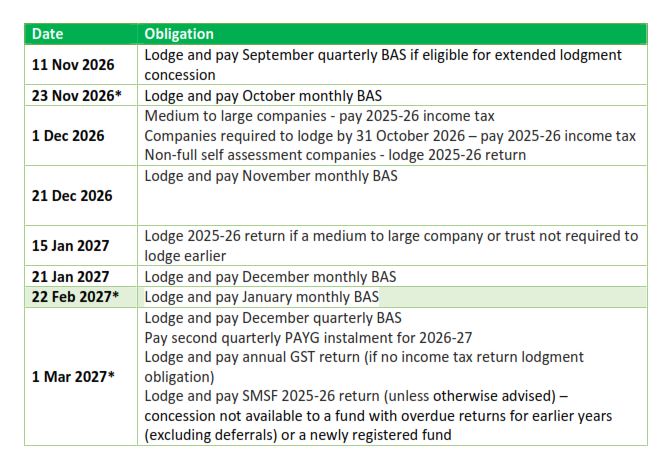
Key Tax Dates
Note!
Talk to your tax agent to confirm the correct due dates for your own tax obligations. For example, your business may be eligible for the two-week lodgment concession for the quarterly BAS or for an extension of time to pay a tax-related liability if impacted by a natural disaster.
DISCLAIMER
TaxWise® News is distributed by professional tax practitioners to provide information of general interest to their clients. The content of this newsletter does not constitute specific advice. Readers are encouraged to consult their tax adviser for advice on specific matters.