Year End Tax Tips
How to reduce your tax bill
We are getting near the end of the tax year (30 June), so you might want to consider ways to reduce your business’ tax bill.
The two simplest ways to do this are to reduce assessable income or increase deductible expenditure. Either way, the business’ taxable income (and thus the amount of tax payable) is reduced.
One way to reduce assessable income for the current income year is to delay sending an invoice to a customer until after 30 June, if your business reports income on a cash basis. Of course, cash flow issues may dictate otherwise.
If you are in the process of selling property and the profit will be taxable as a capital gain, you could defer the sale until the next income year – but remember that the liability to pay capital gains tax (CGT) arises when you exchange contracts and not on settlement.
You can increase deductible expenditure by bringing it forward from the next income year to the current income year. This is particularly useful where an immediate deduction is available — for example, for certain depreciating assets if you are a small business, start-up costs and certain prepaid expenses.
Charitable donations are a good way to increase your deductions. If you are not sure if a donation will be deductible, you can check the deductibility status of charities at https://www.abn.business.gov.au/Tools/DgrListing. In certain circumstances, a deduction is available where trading stock is donated. Don’t forget to ask for a receipt.
What are the benefits?
If you are a sole trader or a partner in a partnership, the benefits of reducing your taxable income could include:
- reducing your marginal tax rate, for example, from 37% to 30%, or from 30% to 16%; and
- avoiding liability for the Medicare levy surcharge (MLS) (at least 1% of your income for MLS purposes) if you do not have appropriate level of private health insurance hospital cover.
Tip!
As the end of the income year approaches, talk to your tax adviser about ways to minimise your tax bill.
Division 7A issues
If you operate your business through a company, you will need to consider any arrangements between the company and associated entities, such as shareholders and trusts, involving a loan, the forgiveness of a debt or the use of the company’s assets, to see if a deemed dividend under Division 7A might arise.
You should ensure that the required minimum yearly repayments (MYR) under complying Division 7A loans are made by 30 June. Appropriate directors’ resolutions are needed for any dividends declared by 30 June that will be ‘offset’ against a shareholder’s obligation to make the MYR.
The ATO is continuing to treat unpaid present entitlements (UPEs) of corporate beneficiaries as Division 7A loans, as it awaits the High Court’s decision on its appeal against a decision that a UPE was not a loan for the purposes of Division 7A (the Bendel case).
Tip!
Division 7A can be a minefield. Talk to your tax adviser to avoid being assessed on an unfranked deemed dividend.
Bad debts
Your business may be entitled to a deduction for bad debts provided the debt is written off before the end of the income year. A debt that is merely doubtful is not deductible. Writing off a bad debt does not necessarily require highly technical accounting entries. It is sufficient that some form of written record is kept to evidence the decision to write off the debt from the accounts. A directors’ resolution should be sufficient.
The debt must have been owed to you and is genuinely bad. This means it must be an amount that you have determined is unlikely to be recovered through any reasonable and commercial attempts.
Unless your business is a money-lending business, a bad debt deduction is not allowed if the debt has not been previously included in assessable income. So, if your business accounts for assessable income on a cash basis, an amount is not included in assessable income until it is received. Therefore, writing off a debt for an amount of unpaid income will have no income tax consequences for your business, as it has never been previously assessed.
If you operate your business through a company, the continuity of ownership or the same/similar business tests must be satisfied. Different tests apply if you operate your business through a trust, depending on the type of trust. Only one test applies — the income injection test — if the trust has made a family trust election (FTE).
Trustee resolutions
If you operate your business through a trust and you wish to make beneficiaries presently entitled to trust income for the 2024–25 income year, you should ensure your trustee resolutions are effective. This includes where you may want to make beneficiaries specifically entitled to franked dividends and capital gains that are included in trust income to stream these amounts.
Note that you do not have to prepare the trust accounts by 30 June to make beneficiaries presently entitled to trust income.
It is important that the trustee:
- makes decisions consistent with the terms of the trust deed. Check that the trust has not vested, as this may impact distribution decisions;
- consider who the intended beneficiaries are and their entitlement to income and capital under the trust deed. If the trustee has made an FTE or interposed entity election (IEE), this may have a tax impact on distribution decisions;
- notify beneficiaries of their entitlements to allow beneficiaries to correctly report distributions in their tax returns, preventing trust income from being omitted;
- follows any requirements in the trust deed governing the making of trustee resolutions, including the need to make the resolution in writing and when it is required to be made (there is no standard ATO format). Resolutions making one or more beneficiaries presently entitled to the trust income need to be made by the end of the income year;
- ensures that resolutions are unambiguous; and
- if the trust has capital gains or franked distributions the trustee would like to stream to beneficiaries, confirm the trust deed does not prevent this and that the trustee has complied with the legislative requirements relating to streaming these amounts.
Trustee checklist
To help trustees, the ATO has published a useful checklist in the form of a series of questions.
- Do you have a complete copy of the trust deed?
- Who can you appoint income or capital to?
- Has the trust vested?
- Is there an FTE in force for the trust?
- When do you have to make resolutions?
- Does a resolution have to be in writing?
- Is the wording of your resolution clear and unambiguous?
- Is the entitlement vested?
- Can the entitlement be taken away?
- How should you calculate and report the income of the trust?
- Are you ‘streaming’ capital gains or franked distributions?
- Are you seeking to ‘stream’ other types of income?
- Have all entitled beneficiaries quoted their tax file number (TFN) to you?
Family trusts
Family trust distribution tax (FTDT) happens when a trust that has made an FTE, or an entity that has made an IEE, makes a distribution outside the ‘family group’ of the individual specified in the FTE. This includes when distributing to another entity. The rate of FTDT is 47%.
So, where an FTE or IEE has been made, it is important to identify who is in the family group.
For non-fixed (discretionary) trusts to be within the family group of the individual specified in the FTE of another trust, they would need to have either:
- an FTE with the same specified individual in place; or
- an IEE as a member of the specified individual’s family group.
There is also a risk of not satisfying the qualified person rules where dividends are paid to a discretionary trust that has not made a family trust election. This means there could be restrictions or even the inability for the trust to pass on to beneficiaries franking credits attached to distributions of dividend income.
Tip!
Talk to your tax adviser – they can help you ensure that trustee resolutions are effective and that no liability to FTDT will arise.
FBT thresholds and rates - 2026-27
The FBT rate (47%) and the gross-up rates - 2.0802 where the benefit provider is entitled to a GST credit (type 1 gross-up rate) and 1.8868 where the benefit provider is not entitled to a GST credit (type 2 gross-up rate) - are unchanged from the 2025-26 FBT year.
Cents per km rates
The rates to be applied for the 2026-27 FBT year where the cents per kilometre basis is used to calculate the taxable value of a fringe benefit arising from the private use of a motor vehicle other than a car are:
- 0-2500 cc engine capacity - 70 cents;
- over 2500 cc engine capacity - 82 cents;
- motorcycles - 20 cents.
LAFHA – reasonable food and drink amounts
The ATO has published the amounts considered to be reasonable for food and drink expenses incurred by employees receiving a living-away-from-home allowance (LAFHA) fringe benefit for the FBT year commencing 1 April 2026.
The amounts considered reasonable where the employee is living away from home in Australia are set out in the table below. Your tax adviser can let you know the reasonable amounts where the employee is overseas.
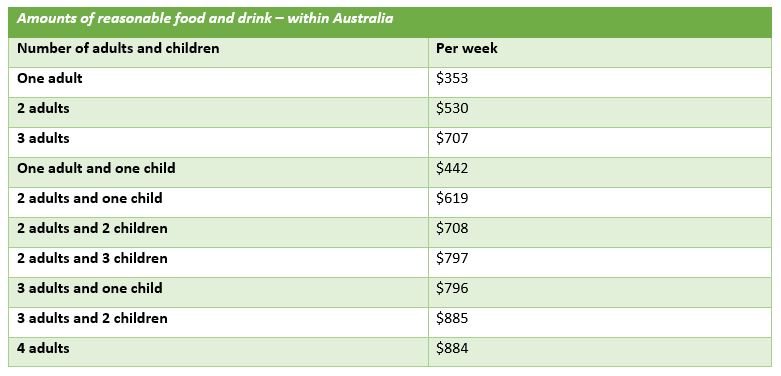
In relation to larger family groupings, the ATO accepts the reasonable food and drink amount based on the figures in the table above, plus:
- $177 for each additional adult; and
- $89 for each additional child.
An adult is a person who is more than 12 years old before the beginning of the FBT year.
Other 2026-27 thresholds and rates
- Statutory or benchmark interest rate – 8.27%
- Car parking threshold - $11.48
- EV home charging rate - 5.4 cents per kilometre
- Record keeping exemption threshold - $10,962.
From the ATO
Final countdown to Payday Super!
Payday Super is almost here. It starts on 1 July, which is less than four weeks away. Among other things, your business needs to:
- if you’re still using the Small Business Superannuation Clearing House (SBSCH), transition to an alternative provider;
- set up a process to quickly correct any errors with super contributions so the super fund receives the contribution within 7 business days after payday;
- understand the new concept ‘qualifying earnings’ (QE).
Avoid the super guarantee charge (SGC) by paying your eligible employees’ super in full, on time and to the correct fund. For Payday Super, this means contributions need to be received by, and can be allocated by, the super funds within 7 business days after payday (unless longer applies). Pay super on payday as you need to allow time for payment processing and any corrections to be made.
Tip!
If you are unsure if your business is fully prepared for Payday Super, talk to your professional adviser.
Business deductions
Your business can claim a tax deduction for most expenses it incurs in carrying on the business if they are directly related to earning assessable income.
There are three golden rules for a valid business deduction:
- The expense must have been for your business, available as an allowable deduction and not for private use.
- If the expense is for a mix of business and private use, you can only claim the portion that is used for your business.
- You must have records to prove it.
Types of business expenses that are generally deductible include:
- certain capital expenses, such as the cost of depreciating assets like machinery and equipment used in your business;
- day-to-day operating expenses;
- purchases of products or services for your business.
You can also claim deductions for expenses related to protecting staff from safety hazards involved in performing their duties. For example, infection from transmissible diseases. This may include hand sanitiser, sneeze or cough guards, face masks, gloves, other personal protective equipment, antibacterial wipes and other cleaning supplies that are used for business purposes.
The amount of the deduction and when it can be claimed will depend on:
- the type of expense (for example, certain capital expenditures are deductible over time);
- whether it has any private or domestic purpose for which the deduction must be reduced.
The GST component of expenses cannot be claimed as a deduction if it can be claimed as a GST credit on a business activity statement.
What you can't claim
There are some expenses that are not deductible, such as:
- entertainment expenses, other than those provided as an entertainment-related fringe benefit;
- traffic fines;
- private or domestic expenses, such as childcare fees or clothes;
- expenses relating to earning income that is not assessable;
- payments for which your business has not met its PAYG withholding or reporting obligations;
- the GST component of a purchase if it can be claimed as an input tax credit;
- general interest charge or shortfall interest charge incurred on or after 1 July 2025 – if you’re an entity with a substituted accounting period, these changes apply from your next accounting period starting after 1 July 2025.
You generally cannot claim a deduction for the cost of capital assets that are dealt with under the capital gains tax rules, such as the land your business premises are on. Some exceptions apply for capital works, plant and certain expenditure of primary producers on improvements to land.
If you earn personal services income (PSI) and the PSI rules apply, the PSI rules will limit the deductions you can claim in relation to your PSI.
How to apportion expenses
You cannot claim a deduction for an expense to the extent it is incurred for a private or domestic purpose. Thus, if an expense only partly relates to running your business it will need to be apportioned between the deductible and non-deductible amounts.
If you have a home-based business and claim occupancy expenses, you will generally apportion these based on floor area and the time your home is used in your business. For running expenses, there is a variety of methods you may use depending on your circumstances.
There are different methods you can use to calculate deductions for motor vehicle expenses, depending on your business structure and the type of vehicle you are claiming them for.
For other expenses, you will generally apportion based on the private and business use of the asset or service acquired. This must be done on a fair and reasonable basis that reflects any private use of the asset or purpose of the expense.
You need to keep records to show how you have apportioned your expense. For example, if you incur an expense to repair your laptop which you only use for your business, you can claim a deduction for the full cost of the repair. However, if you use the laptop 50% of the time for your business and 50% of the time for private use, you can only claim a deduction for 50% of the cost of the repair.
Example: expenses that have both business and private purposes
Jax is a make-up artist who runs a business teaching make-up techniques and promoting make-up and products for profit through multiple online channels.
Jax purchases make-up for use in that business but also uses some of the make-up they purchase for personal use. They estimate this to be about 50% with the remainder used in their teaching business. Jax is only able to claim a deduction for 50% of the cost of the make-up.
Claiming a deduction for a prepaid expense
There are different rules for expenses you pay in advance – that is, expenses incurred now for goods or services will be received (in whole or in part) in a later income year.
Where the expense is $1,000 or more, the expense will usually be apportioned (or distributed) across the whole supply or service period if the goods or services are not received in full within 12 months and an immediate deduction is not available.
When you can claim a deduction
The type of expense – operating expense or capital expense – determines when your business can claim a deduction. Generally:
- operating expenses (such as office stationery and wages) are the deductible in the year they are incurred;
- certain capital expenses (such as depreciating assets and capital works assets) are deductible over a longer period – however, an immediate deduction may be available for the business use portion of depreciating assets acquired for your business if it is a small business entity and it uses the simplified depreciation rules;
- other capital expenses (such as start-up expenses) may be immediately deductible or claimed over time.
When the simplified depreciation rules apply
The simplified depreciation rules apply to small business entities (aggregated annual turnover under $10 million) that choose to use them.
The rules apply to most depreciating assets. These are assets that have a limited life expectancy (effective life) and can reasonably be expected to decline in value (depreciate) over the time they are used.
Depreciating assets include:
- computers, laptops and tablets;
- motor vehicles (for example, cars, vans and tractors);
- office equipment (for example, coffee machines);
- office furniture (freestanding);
- tools and equipment (for example, electric sanders and saws).
Excluded assets
A small number of assets are specifically excluded from the simplified depreciation rules. For these assets, you must use the general depreciation rules for:
- assets that are leased out, or expected to be leased out, for more than 50% of the time on a depreciating asset lease;
- assets used in your research and development (R&D) activities;
- assets you allocated to a low-value assets (pool) before using the simplified depreciation rules;
- capital works, including buildings and structural improvements horticultural plants, including grapevines;
- software allocated to a software development pool (but not other software).

If you are a primary producer, for some primary production assets you can use either the general depreciation provisions, or the simplified depreciation rules.
Cost of asset
Under the simplified depreciation rules (including instant asset write-off), the cost of an asset includes both:
- the amount you paid for it; and
- any additional amounts you spent on transporting and installing it ready for use.
The cost also includes amounts you spent on improving, disposing of or permanently ceasing use of the asset.
GST
Whether the goods and services tax (GST) amount is excluded from the cost of your asset depends on whether you are registered for GST.
If your business is:
- registered for GST and can claim the full GST credit – you exclude the GST amount paid on the asset when calculating the asset's cost. This is because you will claim a credit for the GST paid in the business activity statement for the relevant period;
- not registered for GST – you include the GST amount paid on the asset when working out the asset's cost.
If only a portion of the GST credit can be claimed, then the cost is reduced by the portion claimed.
Trade-ins
When your business trades-in a car or any other asset, the agreed price of the trade-in is usually deducted from the amount paid for the new asset. While the sale and purchase may appear as one transaction, there are two transactions for depreciation purposes:
- purchase of a new asset; and
- disposal of an existing asset.
If the cost of the new asset (including any amount credited for the trade-in) is equal to or more than the relevant instant asset write-off limit ($20,000), it can't be immediately written-off and must be added to the small business pool.
Example: trade-in asset depreciation
Marilyn has a ceramic studio, that she runs as a sole trader and that qualifies as a small business. Marilyn trades-in her old car for $11,000 and buys a second-hand car at a cost of $25,000. Both cars are used 100% for business purposes.
For depreciation purposes, there have been 2 transactions:
- purchase of the new car for $25,000; and
- sale of the existing car for $11,000.
Although only $14,000 out of pocket, Marilyn must add the car to the small business pool because it cost $25,000, which exceeds the relevant instant asset write-off limit of $20,000.
Marilyn may need to adjust her small business pool balance or include an amount in her assessable income as a result of selling the old car.
Improvements to assets
Under the simplified depreciation rules, improvements to assets are depreciated.
If the improvement relates to an existing asset in the small business pool, you simply add the improvement cost to the pool as a cost addition amount. You also add costs incurred when disposing of, or permanently ceasing to use, an asset to the pool as a cost addition amount.
The amount of any cost addition that can be claimed is limited to the business use proportion (taxable purpose proportion) of the original asset. This is the portion used to earn assessable income.
If your business has a cost addition for an asset that has been written-off under the instant asset write-off rules in a previous income year, you can immediately deduct the cost addition amount under the instant-asset write off rules if:
- it is the first deductible cost addition amount incurred after the end of the income year in which the asset was written off;
- the cost addition amount is less than the instant asset write-off limit for the income year.
Any subsequent cost addition amounts can't be immediately deducted – instead they are placed into the small business pool.
Business versus private use
The amount of an asset's cost that can be claimed as a depreciation deduction is determined by how much the asset is used for business purposes (taxable purposes).
To work out if you can immediately deduct the cost of a depreciating asset or cost addition under instant asset write-off, you must consider whether the full cost of the asset or cost addition is less than the relevant limit. However, the depreciation deduction is limited to the percentage the asset is used for business purposes. You can't claim a deduction for the portion of the asset used for private purposes.
Changes in business use
You must review how much an asset is used for business and other taxable purposes in each of the first 3 years after the year the asset was added to the small business pool.
If this taxable use proportion changes by more than 10% from the most recent estimate, you must make an adjustment. The adjustment is made to the opening pool balance of the small business pool containing the asset and must be made before you work out the small business pool deductions for the year.
Instant asset write-off
The threshold for the instant asset write-off is $20,000. As reported in the Budget edition of TaxWise, the $20,000 threshold is to be made permanent.
Simplified trading stock rules
Your business can use the simplified trading stock rules if:
- It is a small business with an aggregated turnover of less than $10 million a year or it would be a small business except its aggregated turnover is $10 million or more but less than $50 million; and
- you estimate that the value of trading stock changed by $5,000 or less in the year.
If the simplified rules are used, your business does not have to conduct a formal stocktake or account for the changes in its trading stock’s value.
Estimating stock value
Your estimate will be considered reasonable if:
- your business maintains a constant level of stock each year and you have a reasonable idea of the value of the stock on hand; or
- the stock levels fluctuate but you can make an estimate, based on your business’ records, of the stock it has purchased.
You must undertake your estimate in good faith following a rational process and be able to explain and prove your process if requested.
In making your estimate consider:
- the type of trading stock held (for example, a large range but few items or a small range of many items);
- where and how the stock is stored (for example, one location or several locations);
- how you value stock items (for example, cost price, market selling value or replacement value method);
- the quantity and value of the stock on hand in previous income years;
- whether the value of the stock varies from previous income years or during the income year;
- how you record sales and purchases and how accurate those records are;
- your inventory systems and how accurate they are;
- information from any stocktakes you have undertaken; and
- significant changes to the type and quantity of stock held.
You still claim a deduction for trading stock in the same way other expenses are claimed.
Example: trading stock estimate
Colin is an electrician. He always has a small number of items in his van and workshop that are trading stock. At the end of the previous income year, he valued his trading stock at $6,800.
Colin's business hasn't changed during this income year. He estimates that the quantity of trading stock he holds at the start and end of the year is similar. However, he knows that the cost of most items has increased by around 15% during the year.
He multiplies the value at the start of the year ($6,800) by 1.15, which gives an end of year estimate of $7,820.
The difference between the value of the opening trading stock ($6,800) and the closing trading stock ($7,820) is less than $5,000. This means Colin doesn't need to do a stocktake or account for the change in his trading stock value when working out his assessable income.

Opening value of stock
The value of stock on hand at the start of the income year is the same as the value that was included in your business’ return at the end of the previous year.
If your business didn't have any trading stock in the previous year, the value of the stock on hand at the start of the year is zero ($0). This is likely if, for example, you started a new business in the year or have an existing business but this is the first year it has trading stock.
If you choose not to account for the change in the value of trading stock (under the simplified trading stock rules), the value at the end of the year is considered to be the same as it was at the start of the year.
Change in value of stock
If the difference in the trading stock’s value during the year varied by more than $5,000, use the general trading stock rules.
Under the general trading stock rules, an increase in the trading stock’s value over the year is assessable income, while a decrease is an allowable deduction.
Choosing to do a stocktake
You can choose to do a stocktake. You might make this choice if the:
- value of the stock is increasing and you prefer to increase your business’ assessable income in small increments over a number of years. The alternative would be to make one large adjustment when the increase in stock value reaches the $5,000 threshold;
- value of the stock has decreased and you prefer to reduce assessable income immediately.
If you choose to do a stocktake:
- apply the general trading stock rules; and
- include the change in value of trading stock in your business’ assessable income, even if the change is $5,000 or less.
Note!
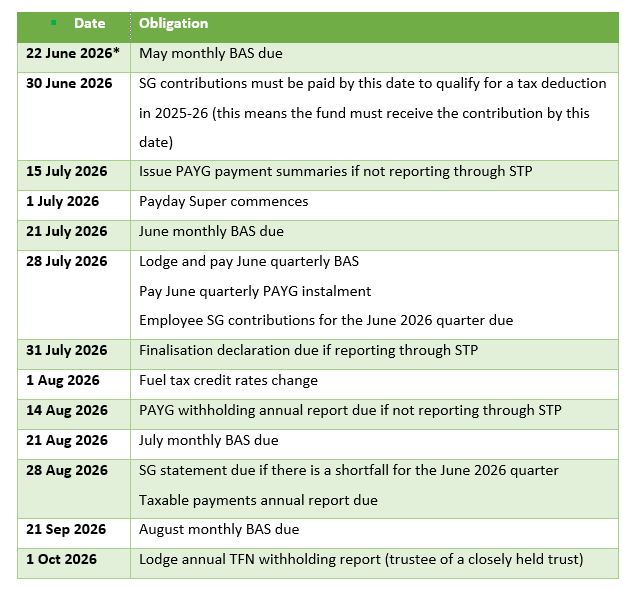
Talk to your registered tax agent to confirm the correct due dates for your own tax obligations. For example, you may have more time to lodge and pay if impacted by a natural disaster.
DISCLAIMER
TaxWise® News is distributed by professional tax practitioners to provide information of general interest to their clients. The content of this newsletter does not constitute specific advice. Readers are encouraged to consult their tax adviser for advice on specific matters.